Área Natural Protegida Lago de Texcoco
Description
Location

Sketch
Information about lithology/geochemistry:
The area is dominated by Quaternary alluvial deposits, volcanic sequences, and saline lake sediments, resulting in highly alkaline and saline soils.
Main Description
- Part of the Panuco Hydrological Region, essential for flood control and aquifer recharge in the Valley of Mexico.
- Intermittently flooded lake wetland with saline soils, vital for migratory birds and hydrological regulation.
- The demosite enhances ecohydrological processes by constructing artificial wetlands, restoring natural water bodies, and applying nature-based solutions for wastewater treatment, flood control, and habitat regeneration.
Enhance ecohydrological processes in novel ecosystem
YES
Apply complementary Ecohydrological processes in high impacted system
YES
This table presents the different categories of ecosystem services that ecosystem can provide, divided in:
Provisioning Services are ecosystem services that describe the material or energy outputs from ecosystems. They include food, water and other resources.
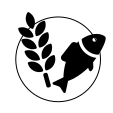
Food: Ecosystems provide the conditions for growing food. Food comes principally from managed agro-ecosystems but marine and freshwater systems or forests also provide food for human consumption. Wild foods from forests are often underestimated.

Raw materials: Ecosystems provide a great diversity of materials for construction and fuel including wood, biofuels and plant oils that are directly derived from wild and cultivated plant species.
Regulating Services are the services that ecosystems provide by acting as regulators eg. regulating the quality of air and soil or by providing flood and disease control.

Local climate and air quality: Trees provide shade whilst forests influence rainfall and water availability both locally and regionally. Trees or other plants also play an important role in regulating air quality by removing pollutants from the atmosphere.
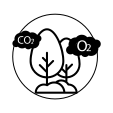
Carbon sequestration and storage: Ecosystems regulate the global climate by storing and sequestering greenhouse gases. As trees and plants grow, they remove carbon dioxide from the atmosphere and effectively lock it away in their tissues. In this way forest ecosystems are carbon stores. Biodiversity also plays an important role by improving the capacity of ecosystems to adapt to the effects of climate change.
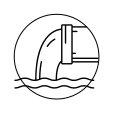
Waste-water treatment: Ecosystems such as wetlands filter both human and animal waste and act as a natural buffer to the surrounding environment. Through the biological activity of microorganisms in the soil, most waste is broken down. Thereby pathogens (disease causing microbes) are eliminated, and the level of nutrients and pollution is reduced.

Erosion prevention and maintenance of soil fertility: Soil erosion is a key factor in the process of land degradation and desertification. Vegetation cover provides a vital regulating service by preventing soil erosion. Soil fertility is essential for plant growth and agriculture and well functioning ecosystems supply the soil with nutrients required to support plant growth.
Ecosystem services "that are necessary for the production of all other ecosystem services". These include services such as nutrient recycling, primary production and soil formation.

Habitats for species: Habitats provide everything that an individual plant or animal needs to survive: food; water; and shelter. Each ecosystem provides different habitats that can be essential for a species’ lifecycle. Migratory species including birds, fish, mammals and insects all depend upon different ecosystems during their movements.

Maintenance of genetic diversity: Genetic diversity is the variety of genes between and within species populations. Genetic diversity distinguishes different breeds or races from each other thus providing the basis for locally well-adapted cultivars and a gene pool for further developing commercial crops and livestock. Some habitats have an exceptionally high number of species which makes them more genetically diverse than others and are known as ‘biodiversity hotspots’.
Cultural Services corresponds nonmaterial benefits people obtain from ecosystems through spiritual enrichment, cognitive development, reflection, recreation, and aesthetic experiences.

Tourism: Ecosystems and biodiversity play an important role for many kinds of tourism which in turn provides considerable economic benefits and is a vital source of income for many countries. In 2008 global earnings from tourism summed up to US$ 944 billion. Cultural and eco-tourism can also educate people about the importance of biological diversity.

Spiritual experience and sense of place: In many parts of the world natural features such as specific forests, caves or mountains are considered sacred or have a religious meaning. Nature is a common element of all major religions and traditional knowledge, and associated custos are important for creating a sense of belonging.
EH Principles
Quantification of the hydrological processes at catchment scale and mapping the impacts
Distribution of ecosystems and their relevant processes (ex: metabolism=water and nutrient uptake and retention; biomass production)
Ecological engineering (integration, dual regulation and biotechnologies in catchment scale for enhancement of ecological potential)
ECOHYDROLOGY ENGINEERING SOLUTIONS
With the support of the population that lives near the lake and the analysis of the composition of the wastewater in the area, lines of action were defined that have as their basis solutions based on nature: water treatment by means of wetlands, an alternative that will allow the quality of the lake's water to be recovered.
 Ecohydrological Infrastructure
Treatment wetlands are wastewater treatment systems, specifically designed to separate contaminants from wastewater and carry out a recovery to return clean water to the environment, in this case to improve the water that enters Lake Texcoco. Its fundamental function is to carry out the management and disposal of waste in an appropriate manner.
 Phytotechnology
Major Issues
- Pollutants and nutrients from wastewater discharges and urban runoff degrade water quality in rivers and lagoons, threatening aquatic life and ecosystem health
- Intensive land use, driven by urban expansion and historical infrastructure projects, has fragmented the natural landscape and reduced the area available for wetland restoration
- Water over-abstraction from the aquifer has lowered groundwater levels, contributing to land subsidence and reducing natural water availability for ecosystems
- Floods frequently affect adjacent urban municipalities due to lost infiltration capacity, with the lake area struggling to regulate extreme rainfall events
- Invasive species, both flora and fauna, outcompete native biodiversity, alter habitat structure, and disrupt ecological functions
- Droughts and climate variability reduce water availability, stressing native species and increasing habitat vulnerability
- Habitat loss from centuries of drainage, urbanization, and land use change has drastically reduced the extent of native wetlands and their associated species








Expected Outcomes
Recover the water capacity and ecological function of key bodies like Ciénega de San Juan and Lake Nabor Carrillo
Increase the regional capacity for flood control and hydrological regulation for the Valley of Mexico
Improve water quality through natural treatment processes, aiming for a potential capacity of 2.88 m³/s
Enhance biodiversity by providing permanent habitat for native and migratory species, including birds and fish
Restore the cultural and productive heritage of the lake, supporting sustainable practices like ahuautle production
Latest Results
- Ciénega de San Juan expanded from 120 to 370 water-covered hectares
- Laguna Xalapango increased from 100 to 300 hectares
- Over 1 million m³ of water retained annually in new wetland cells
- More than 7 million native plants used for reforestation
- Water quality improvement confirmed by 2024 physicochemical analysis versus 2022 baseline
- Two new bird species registered in 2024, increasing total to over 220 species
Contacts
Adrián Pedrozo Acuña
- director_general@tlaloc.imta.mx
- Instituto Mexicano de Tecnología del Agua
Social ecohydrological system
EH Objectives
EH Methodology
Catchment Ecohydrological sub-system
Objectives
Stakeholders
Catchment Sociological sub-system
Activities